Is dust the only contaminant to be removed?
Dust is rarely the only contaminant to be removed from a surface. More than often, thin oxide layers (which form within days/hours when parts are stored in an uncontrolled environment) must also be removed. Other types of dirt can also accumulate on part surfaces.
Fortunately, laser cleaning systems can remove all types of contaminants at once—not just dust. Aluminum oxide, stainless steel oxide, rust, powder coating, e-coating, and other types of contaminants can be removed as well.
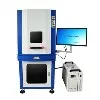
Laser cleaning solutions include handheld lasers, on-the-fly cleaners, rotary tables, robotic arms and more.
Common applications for dust removal
Laser dust removal is used to ensure that surfaces are completely clean before processes such as welding, powder coating and adhesive. In each case, the laser cleaning process must be adjusted to meet specific application requirements.
For example, some manufacturers require a textured surface to improve adhesion prior to coating or bonding processes. Laser systems can be used to do just that by changing the surface roughness as it is being cleaned. This complementary process is known as laser texturing.
For welding applications, the laser does not change the roughness. Rather, it ensures that the integrity of the part is maintained after welding by leaving the metal surface undamaged and by preventing contaminants from entering the welds.
In other cases, parts must be cleaned a second time. This is often the case with shelving, as dust has had time to collect on the surface.
The benefits of laser dust removal
The advantages of laser dust removal are many, providing speed, accuracy, consistency and automation. This is the only method that can realistically process large volumes and be installed directly into production lines, making it an important technology for parts manufacturers. Lasers can also be installed in white rooms where high-tech finishing tasks are carried out.
Fiber laser systems are easy to automate, require no consumables and are low maintenance - leaving no room for human error. Alternatively, manually operated workstations are easy to use as they come with intuitive HMIs.
Fiber lasers can also perform selective dust removal to clean only specific areas, a feat hardly possible with other technologies. This is particularly useful for welding applications where only specific areas need to be cleaned.
Tips for removing laser dust
Successful dust removal is not just about cleaning a surface. Other important considerations must be taken into account:
l After cleaning the parts, handle them with care to avoid recontamination.
l Perform finishing treatments right after the parts are cleaned to prevent dust build-up and oxidation
l Use an efficient vacuum cleaner (with proper airflow) during cleaning to prevent dust from accumulating on the surface.
If you need to remove dust and think laser cleaning is right for you, contact our experts to discuss your requirements.